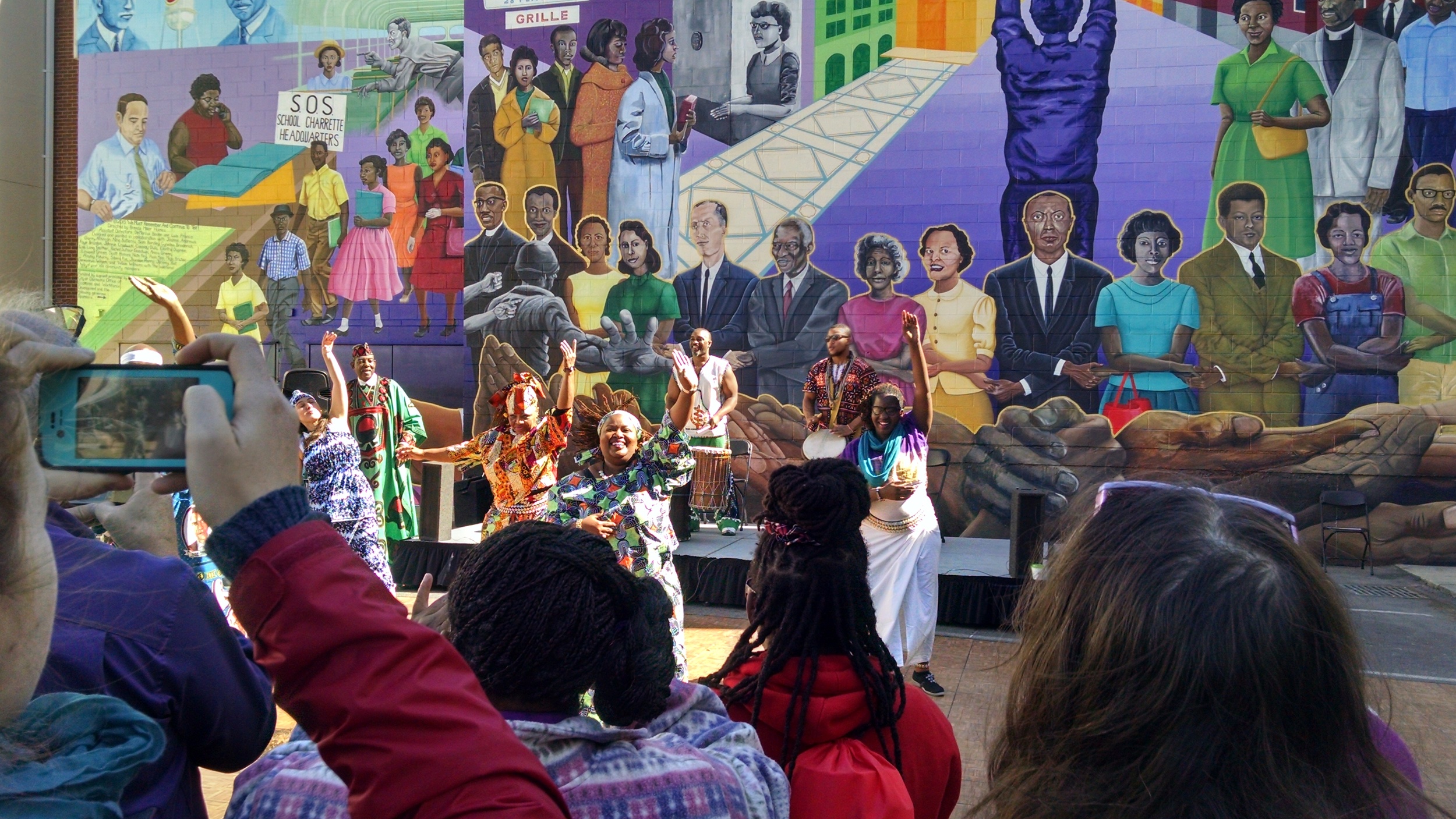
I saw a great example of dance professionals at event that I attended this weekend. At the dedication for the Durham Civil Rights History Mural, a project I was apart of, I recently had a chance to see the talented dancers of Baba Chuck Davis’ African American Dance Ensemble perform. They demonstrated an awesome sense of rhythm, coordination and self expression, which can be applied into many facets of life.
Given the theory of these 9 types of intelligence, there are sure to be many more children that can be successfully reached through incorporating these focuses into the school system. I think applying these aspects into schools will create a great educational value, and show children that they have a future--no matter their interest.
I personally have always considered myself to be a visual learner, which would fit into the spatial intelligence. While I have strengths in other areas of intelligence, one of my strongest is being able to visualize concepts when solving problems or expressing myself through art. I’ve been fortunate to have teachers and mentors who have nurtured and encourage those talents. It’s added a great value to my life to be able to use those skills in my art and in creative problem solving. I now use these skills to develop children’s books that teach in a creative and engaging way through my company, Fundo Press.
I’m sure that many of us can remember a time in our childhood when we realized what we wanted to be. We may have seen a teacher, a chef, an artist, a musician, or a technician in some field doing what they loved. We remember how that person made an impact on other people through their work, and we were inspired. I think every child deserves to see the opportunities that lie in their natural abilities, given the right amount of dedication. For many children, seeing a future version of themselves is what allows children to see the value in learning. It provides them with a boost of self esteem and a purpose for learning.
Thoughts and Questions
There are many benefits of applying ‘multiple intelligence’ into the learning structure for children. As different children have different strengths and talents, we can’t expect an education system that is one size fits all. A system/systems can be redesigned that recognizes the interests, and strengths of students, and nurturing those strengths.
The lessons of ‘multiple intelligence theory’ can be used to develop lesson plans that effectively reach all students, based on their natural strengths. I think that as children are given more opportunities to explore their talents in school, the better chance they have of being successful with that talent later on in life. To further illustrate, I'm reminded of the 10,000 hour rule, explored by Malcolm Gladwell in his book Outliers. A summary of this concept is that it takes natural talent accompanied by 10,000 hours of practice to fully master a skill. I think if students interests are nurtured early on in life, they'll enjoy learning and build more confidence. If they’re given focused learning experience and the right mentorship, that talent may grow into a career.
I am interested in how aspects of the ‘Multiple Intelligence Theory’ can be applied to close the achievement gap in children of color. In my creative process, I’ll explore how I can further use the MI Theory to develop children’s books and learning products that challenge varying natural strengths of young readers.
Additional Questions
I’d love to hear what you think, as educators, parents, or anyone who’s interested.
Do you know of a way that the multiple intelligence theory is currently used effectively in schools?
Do you have ideas for incorporating them into your classroom or home?
Please share your thoughts below in the comments section.
Resources
Here is a 5-minute Multiple Intelligence assessment quiz that will help you determine your intelligence type
http://www.edutopia.org/multiple-intelligences-assessment
Sources
http://www.edutopia.org/multiple-intelligences-assessment
http://examinedexistence.com/the-nine-different-types-of-intelligence/
https://nces.ed.gov/nationsreportcard/studies/gaps/
http://skyview.vansd.org/lschmidt/Projects/The%20Nine%20Types%20of%20Intelligence.htm
http://study.com/academy/lesson/multiple-intelligences.html
http://testprep.about.com/od/tipsfortesting/a/Kinesthetic_Learning.htm
http://www.thirteen.org/edonline/concept2class/mi/